Writing
Manufacturing a Mandate: The Proposal No One Wants
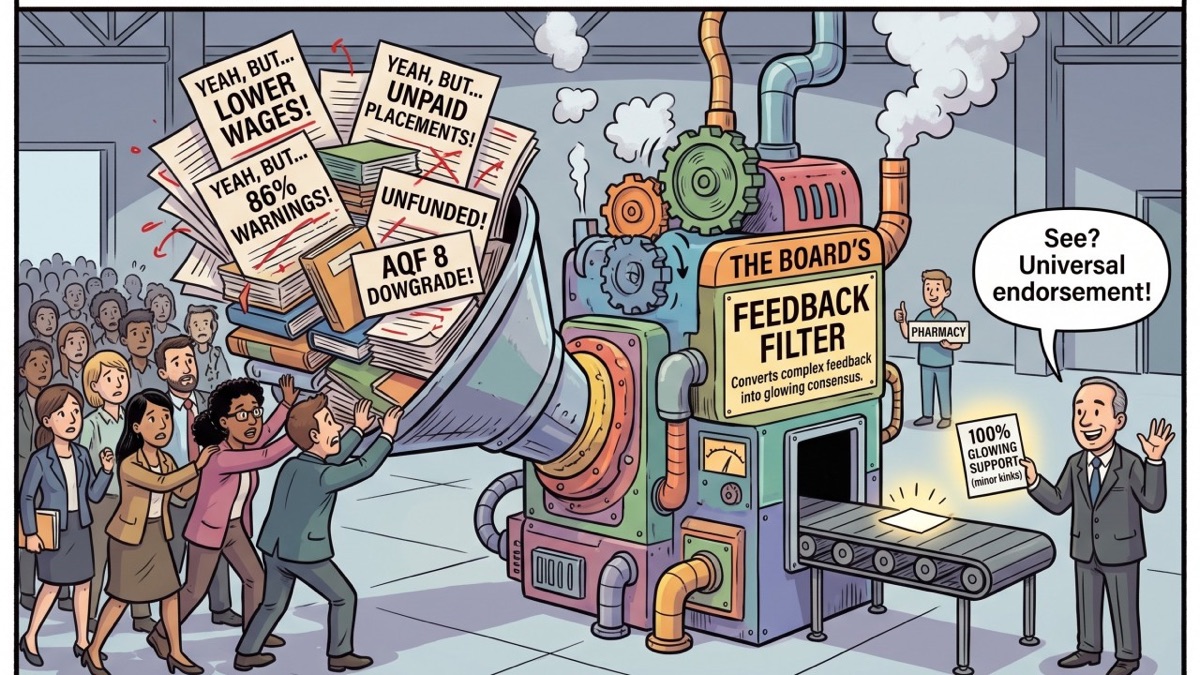
When the Psychology Board recently released their summary of the 2,500 submissions regarding the proposed psychology training reforms, the executive summary was glowing. They pointed to strong endorsement of the model, suggesting there were just a few minor kinks to be worked out in the implementation phase.
As is typical of these consultations, the public submissions are available to read. I was curious if the detail matched the summary, so I set an AI agent loose to download, scan, and summarize the 88 organizational submissions currently available—without an agenda.
What I found paints a very different picture to the PR spin.
Out of 88 organizations representing the mental health, tertiary, and clinical sectors, exactly three offered clear, unqualified support for this redesign. Everyone else led with, “Yeah, but…” (My paraphrase of the gist, not their words.)
- Medibank said, “Yeah but…” what about public safety, and how are we going to price a lower-qualified workforce?
- Dozens of universities said, “Yeah but…” not only does this break our entire funding model, but we can’t afford to pay enough supervisors to do what is being asked.
- Large mental health services like Headspace said, “Yeah but…” the work we do is actually pretty important and difficult, and farming it out to a bunch of teens as part of their training doesn’t seem ideal.
Here is what the rest of the sector actually said:
- 59% explicitly opposed the model.
- 86% flagged the AQF8 downgrade as a massive industrial and regulatory hazard.
- 77% warned that moving placements earlier without funding clinical supervisors will financially break the mental health system.
- 68% pointed out the wealth filter: that unpaid placements will lock out mature-age and lower-SES students.
I don’t want to be all negative, but these don’t sound like minor wrinkles. These sound like fundamental model flaws. Yes, all of these organizations have skin in the game. But collectively, they train practitioners, deliver services, and pay for outcomes. Dismissing their concerns feels like hubris.
Faced with a sector overwhelmingly warning that this proposal will deskill the workforce, exploit students, and collapse under the weight of unfunded supervision, you have to wonder who is providing the “mandate” to push this through.
My AI flagged 3 submissions in the “strong support” category:
- University of Tasmania: The first line of their submission was, “We strongly support the proposal.” However, they proceeded to raise the exact same serious concerns as everyone else in the body of their text.
- Institute of Private Practicing Psychologists: They gave qualified support, though my read was that it was more about the inadequacy of the current system rather than an unqualified endorsement of this specific proposal.
- Australian Pharmacy Council: As far as I could tell, this body was the only group providing full-throated support for the model in its current form.
I love pharmacists. I have worked and published with pharmacists. But with all due respect, when the pharmacists say your psychology proposal is awesome and every single psychology group says “Hell no” or “Yeah but,” you have to wonder if you are onto a winner.
The final report is due in a matter of weeks, which means right now it is sitting in draft form on someone’s laptop. Can I suggest it is time to add the sentence: “More work and consultation needed.”
Epilogue: I know this summary feels like a bit of a whinge. But from reading the raw text of these submissions, I was struck by the open-minded goodwill expressed by the sector. Everyone knows the current training pathway is a complicated mess. Many are eager for reform. I was struck by how many organizations proposed solutions that cut against their own commercial best interests in favor of a better experience for students and the Australian public.
The real power of consultation is harnessing those diverse voices to build something genuinely better. Giving the profession a new model, asking for feedback, and then ignoring it isn’t just disrespectful—it is a squandering of immense goodwill and a tragic lost opportunity.
#protectpsychology
Watch
Also on: LinkedIn