Writing
Voles: what they teach us about monogamy and scientific method
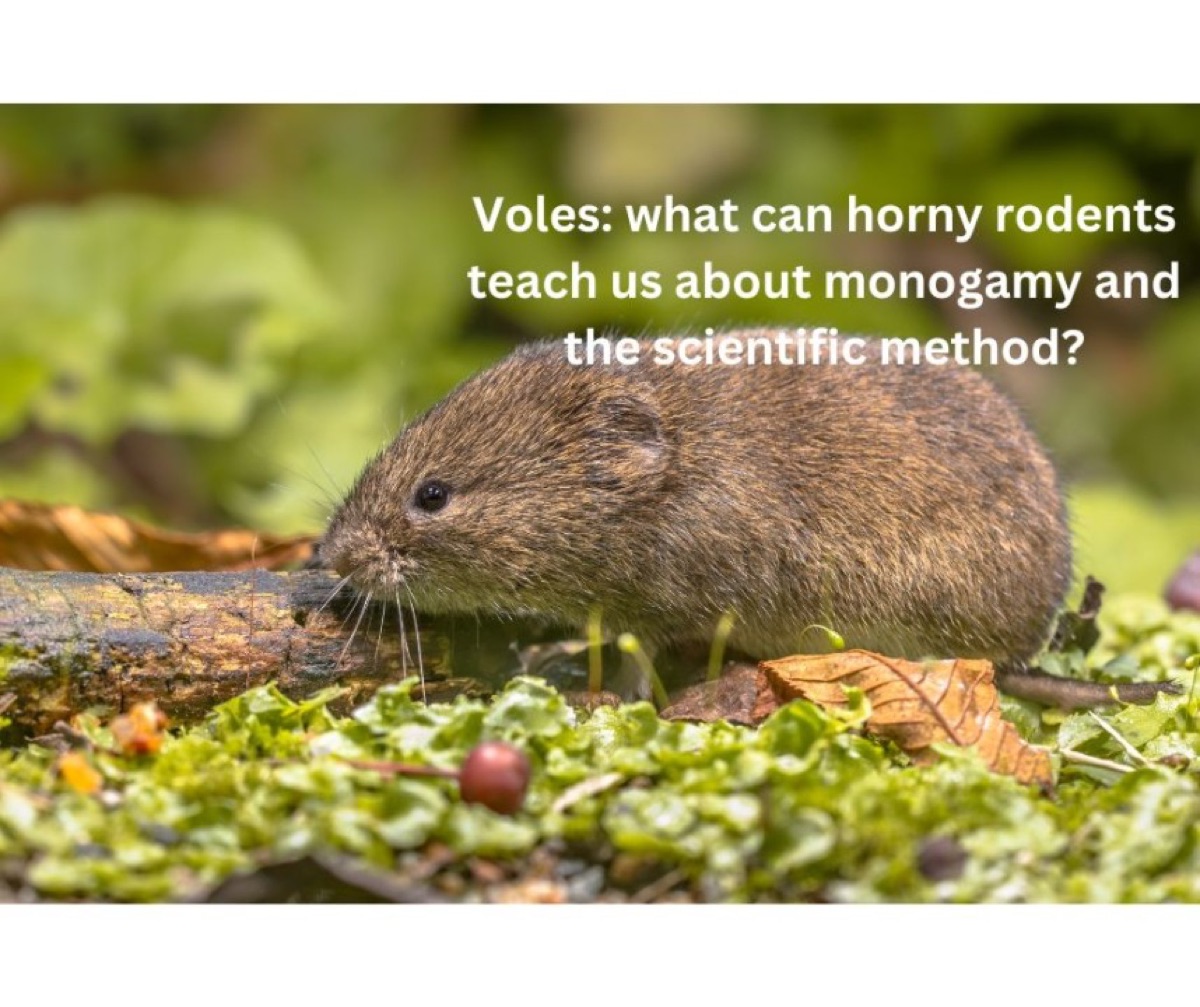
First off, if you aren’t someone interested in evolutionary biology you may not have heard of Voles (rhymes with goals). But they are these cute little relatives of hamsters that have given scientists an incredible insight into monogamy and the role of oxytocin.
Prairie Voles you see are monogamous and mate for life, but not all Voles are such reliable sexual partners, and it turns out that prairie voles have oxytocin reception in just the right place in their brain to make love feel addictive, which led scientists to speculate that this was the chemical signal responsible for pair bonding. This hypothesis was strengthened when scientists gave the voles a drug that blocked oxytocin, and they suddenly became promiscuous little root rats (no pun intended).
In fact, the humble prairie Vole sits at the base of a pyramid of research that has influenced scientists studying everything from sexually transmitted diseases to autism. The vole model of monogamy and oxytocin is now so well known that you can find it in undergraduate psychology textbooks, as well as seemingly infinite blog posts from influencers about every topic under the sun.
However, we have just learned that it might not actually be true.
Before I go on, I just want to clarify that there is no suggestion of scientific fraud here. The vole findings have been replicated by many researchers in many laboratories and are as rock solid as science ever gets. However, earlier this year (2023) a group of scientists used a new method to test the model. They used a gene editing machine technology (CRISPR for those following along at home) to remove the gene for the oxytocin receptor from prairie voles. This basically means that their tiny little brains could no longer pick up the oxytocin signal at all.
Based on previous findings the obvious assumption is that the gene edited voles would be promiscuous. But they weren’t. They went on with their happy pair bonded monogamous lives and in so doing upended one of the most well established findings in evolutionary psychology.
I just want to pause for a second here and say that this is what I love about science. The only thing that refutes good science is better science. The scientists told us that oxytocin makes little rodent dudes and dudettes monogamous, great. As an empiricist, I accept that right up until the point that better science tells me it isn’t true.
So what is going on with the Voles. Well opinion varies. It is possible that the editing process itself is imprecise and maybe we are editing the wrong gene (unlikely). It is also possible that the drugs used to suppress oxytocin in earlier studies had the unfortunate side effect of making the usually monogamous voles ridiculously randy (also unlikely). One of the leading researchers in the field Dr Larry Young (who I had the pleasure of co-presenting with about 5 years ago) suggested that just as a person who is blind from birth learns to develop their other senses; perhaps pair bonding is so crucial to voles that their little brains have to learn to hijack some other neurotransmitter in order to do the job. This is an idea that is increasingly gaining traction in evolutionary biology circles. Perhaps there are no “genes that do certain things”, perhaps there are “certain things that need to be done, and whatever mechanism has spare capacity just kind of steps in”.
The truth is we don’t know yet, and it may take a couple of years for us to find out. What I love about this, and what has forced me to write, is the beauty of the scientific method. When something is wrong, eventually it will be shown as wrong by a better experiment, and eventually our truths become less prone to error.
In my field of psychology I am increasingly watching the power of dogma dominate the debate. A previous “truth” can be overturned by a passionate argument, or a criticism of the method or the character of the researcher. My question is, what then overturns the new truth?; A more passionate argument? a more aggressive ad-hominem attack ?
At the end of the day, the sexual behavior of voles may have very little impact on the lives of any of us. But as a lesson in the power of the scientific method it has re-invigorated me in a way I could not have imagined. The biologist Konrad Lorenz once said “It is a good morning exercise for a research scientist to discard a pet hypothesis every day, it keeps him young”. This kind of ego-less pursuit of the truth is something I feel our field desperately needs more of.
Also on: LinkedIn